Best IWB Holster for Canik TP9SF & TP9SF Elite (2026)
Best IWB Holster for the Canik TP9SF and TP9SF Elite: Complete Buyer’s Guide The Canik TP9SF and TP9SF Elite are mid-size 9mm pistols with a

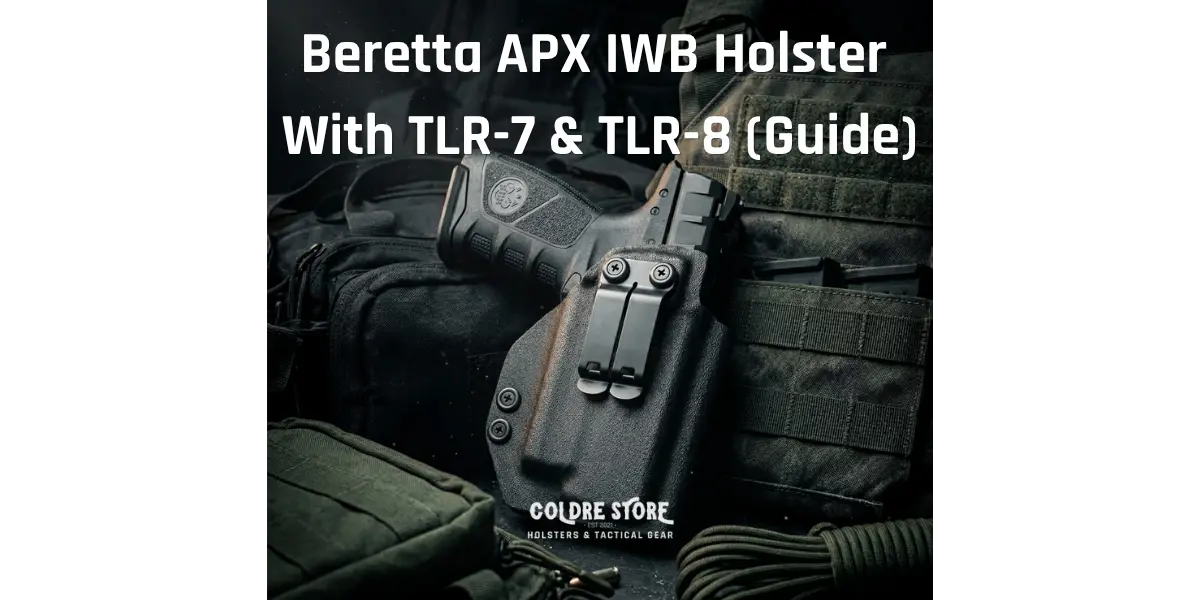
The Beretta APX Full-Size and APX A1 Full-Size are full-service pistols — larger platforms with a 4.25-inch barrel, 7.55-inch overall length, and a full MIL-STD-1913 Picatinny rail built into the frame. When you add a Streamlight TLR-7 or TLR-8 to that rail, the combined profile becomes something no standard APX holster can accommodate. You need a shell precision-molded to the APX’s frame geometry with the specific light body already accounted for in the mold.
Two dedicated light-bearing IWB Kydex holsters exist for this configuration — one molded for the TLR-7/TLR-7A, one for the TLR-8/TLR-8A — at the same price point. This guide covers both, explains which APX variants are compatible (and why several are not), addresses a known APX A1 rail caveat that matters before daily carry, and gives you a practical setup framework for a full-size light-bearing platform.
This is the most critical section of this guide. The Beretta APX family spans five meaningfully different platforms, and assuming any APX fits this holster is the most common ordering mistake.
These holsters are molded for:
These APX variants do NOT fit:
| Variant | Why Not Compatible |
|---|---|
| APX Compact / APX A1 Compact | Shorter slide (6.9″ OAL); different muzzle geometry; requires its own shell |
| APX Carry / APX A1 Carry | Micro-compact; no Picatinny rail; TLR-7 or TLR-8 cannot be mounted |
| APX A1 Tactical | Longer 4.72″ barrel (8.2″ OAL); different slide profile |
| APX Combat | Different dust cover profile and slide geometry |
The requirement isn’t just the correct APX variant — it’s that the pistol has a full Picatinny rail and the correct light mounted. Without the rail, there’s no way to attach the TLR-7 or TLR-8. Without the light mounted, the holster has no functional retention geometry.
→ Beretta APX + Streamlight TLR-7 IWB Kydex Holster — $51.90
The Streamlight TLR-7 is a light-only WML — it produces a high-output white beam with no laser component. The TLR-7A is a functionally updated version with an ambidextrous switch and an improved LED module, but its external body dimensions are identical to the TLR-7. This matters directly for holster selection: if you carry a TLR-7A on your APX, this TLR-7 shell fits your configuration without modification.
The shell is molded around the combined profile of the APX Full-Size or APX A1 Full-Size frame with the TLR-7 body positioned on the rail. The retention screw indexes off the TLR-7 body interface — the light body itself is the primary lock point. Holstering the APX without the TLR-7 attached produces no functional retention.
Specs:
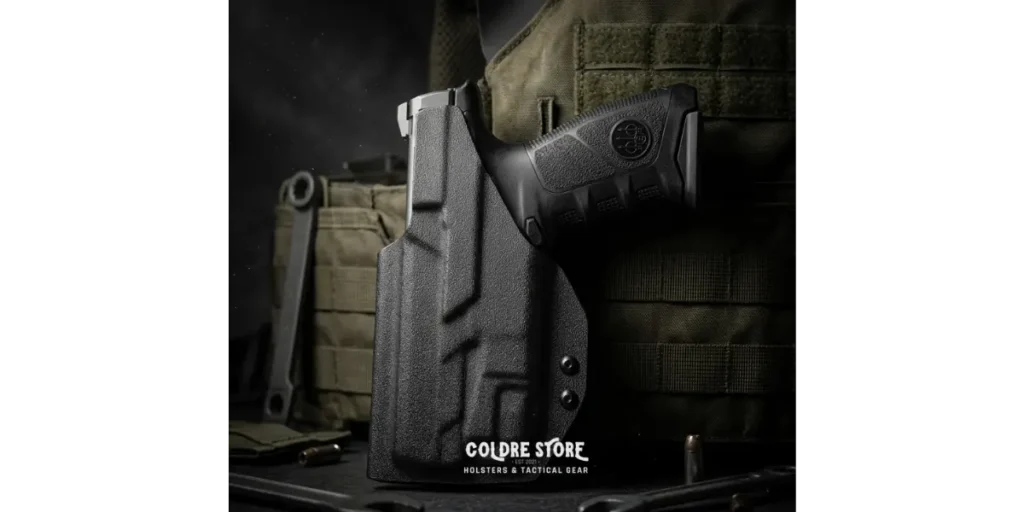
→ Beretta APX + Streamlight TLR-8 IWB Kydex Holster — $51.90
The TLR-8 adds a red laser to the same TLR-7 housing. The TLR-8A replaces the red laser with a green laser. Both the TLR-8 and TLR-8A share the same external body dimensions as the TLR-7 family — but the laser module creates a slightly larger retention contact surface at the lower body than the TLR-7’s light-only housing. This means small adjustments to the retention screw produce proportionally smaller changes in draw resistance on the TLR-8/8A configuration than on a light-only TLR-7 setup. Start with the retention screw looser than you think necessary and tighten incrementally.
Specs:
This is not a marketing note — it’s a functional issue documented in the product description and worth reading carefully before daily carry.
The APX A1’s Picatinny rail can exhibit slight front-to-back play with Streamlight TLR-series lights on some units. This is a characteristic of the APX A1’s specific rail slot dimensions, not a defect in the light itself. The practical effect: the TLR-7 or TLR-8 can shift slightly forward and rearward within the rail even when the lever is tightened, depending on the specific unit.
Why this matters for the holster: the shell indexes retention geometry off the TLR body being in a fixed, consistent position within the mold. If the light can move on the rail, the retention geometry shifts on every draw and reholster, producing inconsistent retention feel and potentially allowing the pistol to sit incompletely seated.
Before daily carry with the APX A1:
The standard APX Full-Size does not have this rail play characteristic to the same degree. If this rail fit concern is a dealbreaker, the standard APX Full-Size is the more reliable platform for this holster configuration.
The Beretta APX and APX A1 are designed with interchangeable grip modules in Small, Medium, and Large sizes. This is one of the APX’s signature features — you can change grip width and hand ergonomics without changing the pistol’s mechanical components.
The holster shell indexes off the slide geometry and trigger guard, not the grip module. Changing grip module size does not affect holster fit, retention geometry, or draw path. If you carry a Medium grip module today and switch to a Large next month, no holster change is needed. This is a genuine advantage of the APX platform for holster owners.
The APX Full-Size at 7.55-inch overall length and approximately 29 ounces unloaded — plus the TLR-7 or TLR-8 adding forward mass — is a substantial IWB carry combination. Setup decisions matter more than they would with a compact.
Carry position: Strong-side hip at 3–4 o’clock with 0° cant is the primary position for this configuration. At 7.55 inches overall with the TLR’s forward mass, the APX’s length distributes most naturally along the hip. A neutral cant keeps the light body away from the lower abdomen and positions the grip where the hand can reach it cleanly without contact against the body.
Appendix carry: Technically possible but substantially more demanding than appendix with a compact or subcompact platform. At 7.55-inch overall and elevated weight, the APX + TLR combination creates more forward bulk at the 12 o’clock position than most carriers find manageable for all-day wear. Test seated-in-vehicle comfort before committing to AIWB. Many carriers who prefer appendix with a compact gun carry the APX strong-side.
Belt: A full-size light-bearing setup loads the belt with meaningful combined weight. A stiff, reinforced carry belt — 1.5-inch minimum — is required. A casual fashion belt will roll inward under the combined APX + WML weight within hours of carry.
Ride height: Start at mid-height with the pistol loaded and TLR mounted. The WML’s forward mass shifts the holster’s effective balance point compared to a bare APX — a ride height setting that worked for a bare gun may need adjustment with the light attached. Test for hip contact and grip accessibility before finalizing.
Since both holsters are the same price, the choice between them is entirely functional — which light configuration serves your carry purpose.
| Feature | TLR-7 / TLR-7A | TLR-8 / TLR-8A |
|---|---|---|
| Illumination | White LED only | White LED + laser |
| Laser | None | Red (TLR-8) or Green (TLR-8A) |
| External dimensions | Standard | Identical to TLR-7; laser adds slightly larger contact surface |
| Holster | TLR-7 shell | TLR-8 shell — not interchangeable |
| Retention calibration | Standard adjustment | Fine adjustment; start looser |
| Best for | Low-light target ID, no laser dependency | Low-light ID + aiming reference at distance |
The TLR-7 and TLR-8 holsters are not interchangeable. Although the light bodies share similar external dimensions, the laser housing on the TLR-8/8A creates enough difference in the mold’s contact geometry that each requires its own dedicated shell. Order the shell that matches the specific light you carry.
Does the TLR-7A fit the TLR-7 holster?
Yes. The TLR-7A shares identical external body dimensions with the TLR-7. The TLR-7 shell accommodates both without modification.
Does the TLR-8A fit the TLR-8 holster?
Yes. The TLR-8A (green laser) and TLR-8 (red laser) share the same external housing geometry. The TLR-8 shell fits both.
Can I use the TLR-7 holster if I have a TLR-8?
No. Although the body dimensions are very similar, the laser housing geometry of the TLR-8 creates a different fit profile in the Kydex mold. Each holster is specific to its light family.
Does the APX Compact fit these holsters?
No. The APX Compact has a shorter slide at 6.9-inch overall length and a different muzzle geometry. It requires its own separately molded shell. These holsters are for the APX Full-Size and APX A1 Full-Size only.
Does grip module size affect holster fit?
No. The APX’s interchangeable grip modules (S/M/L) change grip width and ergonomics but not the slide or trigger guard geometry the shell indexes off. Changing grip modules does not require a different holster.
What’s the APX A1 rail play issue?
The APX A1’s Picatinny rail can exhibit slight front-to-back movement with TLR-series lights on some units. Because the holster’s retention geometry depends on the light body being in a fixed position, play in the rail produces inconsistent retention. Verify the TLR is fully locked with no play before daily carry.
Can I carry the APX + TLR in appendix position?
Technically yes, but the APX Full-Size at 7.55-inch overall and elevated weight makes AIWB carry substantially more demanding than with a compact. Most carriers find strong-side at 3–4 o’clock more practical for all-day wear with this combination.
→ APX + Streamlight TLR-7 IWB Holster — $51.90
Best IWB Holster for the Canik TP9SF and TP9SF Elite: Complete Buyer’s Guide The Canik TP9SF and TP9SF Elite are mid-size 9mm pistols with a
Beretta APX IWB Holster With the Streamlight TLR-7 and TLR-8: Complete Light-Bearing Carry Guide The Beretta APX Full-Size and APX A1 Full-Size are full-service pistols
Best IWB Holster for the Taurus 942, 856, 605 and 85 Revolvers: Complete Guide Snub-nose revolvers are among the most practical concealed carry platforms available
Springfield Hellcat Pro + Olight Baldr S IWB Holster: The Complete Light-Bearing Carry Guide The moment you mount an Olight Baldr S on your Springfield
The Springfield Hellcat Pro is one of the most popular micro-compact pistols on the market — and one of the most misunderstood when it comes