CZ P10C Holster With Light: Compatibility Checklist (No Guessing)
Table of Contents CZ P10C Holster With Light: Compatibility Checklist (So You Don’t Waste Money)


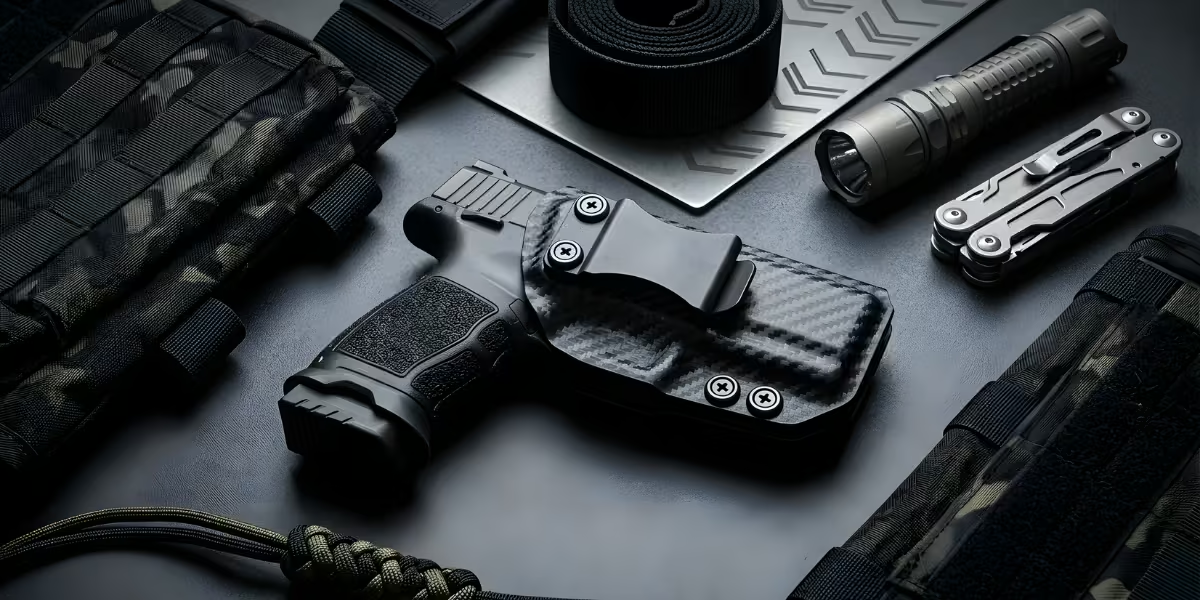
The Tisas Zigana PX9 is a striker-fired, 9mm full-size pistol manufactured in Turkey and imported to the U.S. market by SDS Imports. It’s a well-built, competitively priced service pistol that has gained steady adoption in the American carry market — but its specific slide geometry, aggressive rear serrations, and frame profile require a holster molded precisely for the PX9 platform. Universal fit holsters and multi-platform shells miss the contact points on the PX9 that determine accurate retention and safe trigger coverage. This guide covers the dedicated Kydex IWB holster built specifically for the Zigana PX9.
Before selecting a holster, it’s worth understanding what makes the PX9 geometry distinct — because these are the same characteristics that drive the holster’s design decisions.
The Zigana PX9 is a full-size service pistol with a 4.6-inch barrel, a 7.72-inch overall length, and a loaded weight of approximately 34 ounces. It is built around a polymer frame with a Picatinny accessory rail below the dust cover. The slide features aggressive front and rear serrations — a more pronounced texture than many competing platforms — which is relevant for holster selection because those rear serrations create direct friction against the torso at the sweat guard contact zone during IWB carry.
The PX9 is striker-fired with no external hammer and no manual safety lever, which simplifies the holster mold requirement. There are no external decocking levers, prominent thumb safeties, or external hammer spurs that require additional clearance channels in the shell geometry.
→ Tisas Zigana PX9 IWB Kydex Holster — see current price
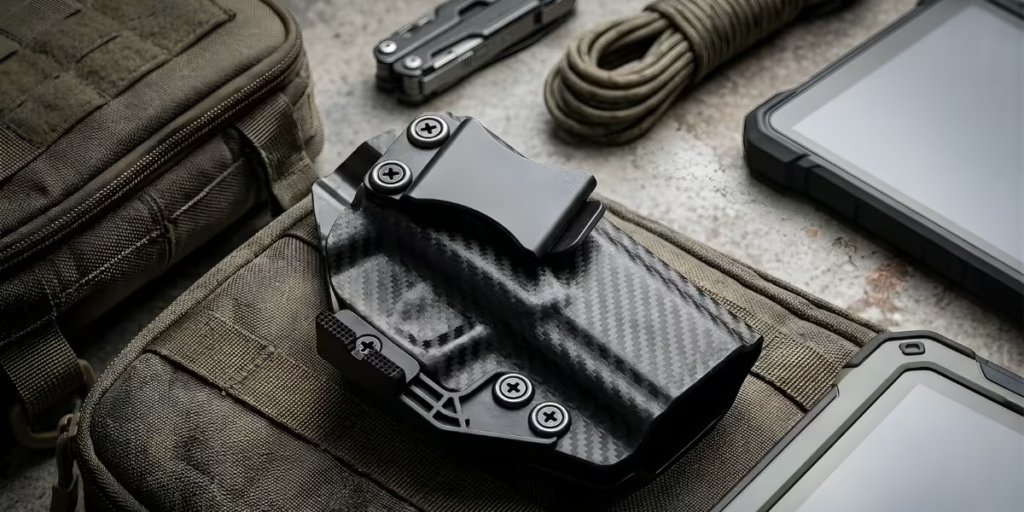
This is a full Kydex IWB shell vacuum-formed strictly to the external dimensions of the Zigana PX9 frame and slide. It is not a universal fit, not a multi-platform shell, and not a modified version of a Glock or CZ mold. The shell is mapped to the PX9’s specific slide contours and grip geometry — meaning the contact points that control retention and trigger coverage are calibrated to this pistol’s exact profile.
The PX9’s rear slide serrations are more aggressive than most competing full-size platforms. In a full Kydex IWB holster, the body-facing side of the shell runs parallel to the slide — and on the PX9, that means the sweat guard makes contact with a slide surface that has sharp, textured serration edges.
The holster addresses this directly: the extended sweat guard rises parallel to the full height of the slide and creates a hard vertical barrier between the PX9’s rear serrations and the carrier’s torso. This serves two functions simultaneously — it prevents the serration edges from abrading the skin during movement and draw cycles, and it blocks body perspiration from reaching the metallic slide components during extended daily carry.
This is not a detail most universal-fit holsters account for, because they’re not built around the PX9’s slide profile. On a holster molded to a different pistol and forced to fit the PX9, the sweat guard height and position will be calibrated to a different slide — which means the rear serration protection coverage is off by default.
The PX9 holster uses dual steel tension screws positioned directly beneath the trigger guard area. This dual-screw setup gives the user more precise control over draw resistance than a single-screw system — you can tighten or loosen in quarter-turn increments to dial in the exact resistance feel you want. The draw path itself is governed entirely by the friction geometry of the shell at the trigger guard contact point; there is no mechanical locking device.
| Feature | Spec |
|---|---|
| Compatibility | Tisas Zigana PX9 — standard (non-light-bearing) |
| Shell material | 0.08″ Kydex, vacuum-formed to PX9 profile |
| Trigger guard coverage | Full bilateral encapsulation |
| Sweat guard | Extended, parallel to full slide height |
| Retention | Passive friction-fit, dual steel adjustment screws |
| Retention screws position | Directly beneath trigger guard |
| Light-bearing | No |
| Handedness | Right Hand, Left Hand |
| Colors | Standard, Carbon Fiber |
| Price | see current price |
The Tisas Zigana PX9 is not a widely carried platform in the same volume category as Glock 19 or Sig P320, which means the aftermarket holster supply for it leans heavily toward universal-fit and “compatible with” solutions built on molds from other pistols. This is worth understanding before ordering.
A holster listed as “compatible with Zigana PX9” may be a modified CZ, Canik, or generic striker-fired mold with marginal dimensional overlap. The contact points that determine retention accuracy — specifically the trigger guard geometry and the frame contact zone at the grip junction — are not interchangeable across different full-size 9mm platforms, even when they look visually similar. A shell that doesn’t match the PX9’s actual frame dimensions will produce one of two results: either the retention is unreliable (too loose because the contact points don’t engage correctly), or the pistol won’t fully seat (too tight in the wrong places because the mold follows a different frame geometry).
The dedicated shell for the PX9 is vacuum-formed to the actual PX9 frame dimensions — which is what produces predictable, calibratable retention behavior and correct trigger guard coverage on this specific pistol.
The PX9 is a full-size service pistol at 7.72 inches overall and approximately 34 ounces loaded. IWB carry is fully practical with this platform, but the setup decisions are more consequential than they are with a compact or subcompact.
The natural carry position for the PX9. The full 7.72-inch overall length distributes along the hip contour at 3–4 o’clock where the body’s natural curve accommodates the slide length. Start with a 5° forward cant — at 0° the muzzle end can create pressure against the lower hip on a full-size slide of this length. The 5° angle keeps the grip accessible and the muzzle end from digging in during extended seated periods.
Ride height: Set the initial ride height so the grip sits just at or slightly below the beltline. The PX9’s full-size grip is tall — if ride height is set too high, the upper portion of the grip will print visibly against a shirt or jacket. Most PX9 carriers need to drop the ride height at least one position lower than what feels instinctively comfortable on first setup.
Possible but demanding at full-size dimensions. The 4.6-inch barrel and 7.72-inch overall length require adequate torso length below the beltline at 12 o’clock. The PX9’s aggressive rear serrations — while protected from the torso by the sweat guard — do concentrate against the lower abdomen contact area at AIWB more than a smooth-sided slide would. Test comfort when seated in a vehicle before committing to daily AIWB carry.
A viable secondary option for full-size carry if AIWB is uncomfortable. Behind-the-hip positioning moves the grip off the hip bone onto the flatter section of the lower back, which reduces the impact of the full-size grip height on printing. The trade-off is a slower draw with a more deliberate rearward reach.
The dedicated PX9 Kydex shell is built for one platform in one configuration:
The Tisas Zigana PX9 has a smaller holster aftermarket than Glock, Sig, or S&W platforms — which means most buyers searching for PX9 holsters encounter either generic universal-fit options or poorly adapted shells from other molds. The dedicated precision-molded option for the PX9 is the correct solution for daily carry: it produces accurate retention calibration, correct trigger guard coverage, and the serration-specific sweat guard geometry that the PX9’s aggressive slide texture requires.
At the current product-page price, the PX9 holster is not a premium upcharge for a less common platform. It’s the same build spec and price point as any other dedicated Kydex IWB shell in the lineup.
Yes. The Coldrestore Kydex IWB Holster is vacuum-formed specifically to the PX9 frame and slide dimensions — not adapted from a different platform’s mold.
No. The PX9 has distinct frame geometry at the trigger guard and frame contact zones that don’t match Glock or CZ dimensions. Using a mismatched shell produces unreliable retention at best and incorrect trigger guard coverage at worst.
Yes. The extended sweat guard runs parallel to the full slide height and creates a hard barrier between the PX9’s rear serrations and the carrier’s torso, preventing abrasion and blocking perspiration transfer to the slide.
Not with this holster — it is designed for standard, non-light-bearing PX9 configurations only. A dedicated light-bearing shell is required for WML setups.
5° forward cant at the strong-side hip position is the standard starting point for a full-size service pistol at this overall length. Adjust based on body geometry and clothing after the first week of carry.
Double — dual steel tension screws beneath the trigger guard. Always adjust both screws in matching increments to maintain even draw resistance across the full draw path.
→ SHOP Tisas Zigana PX9 IWB Kydex Holster — see current price
Table of Contents CZ P10C Holster With Light: Compatibility Checklist (So You Don’t Waste Money)
Taurus G3C Holster With Light (GM23, Baldr S/Mini, PL Mini 2): Fit Checklist So you’re
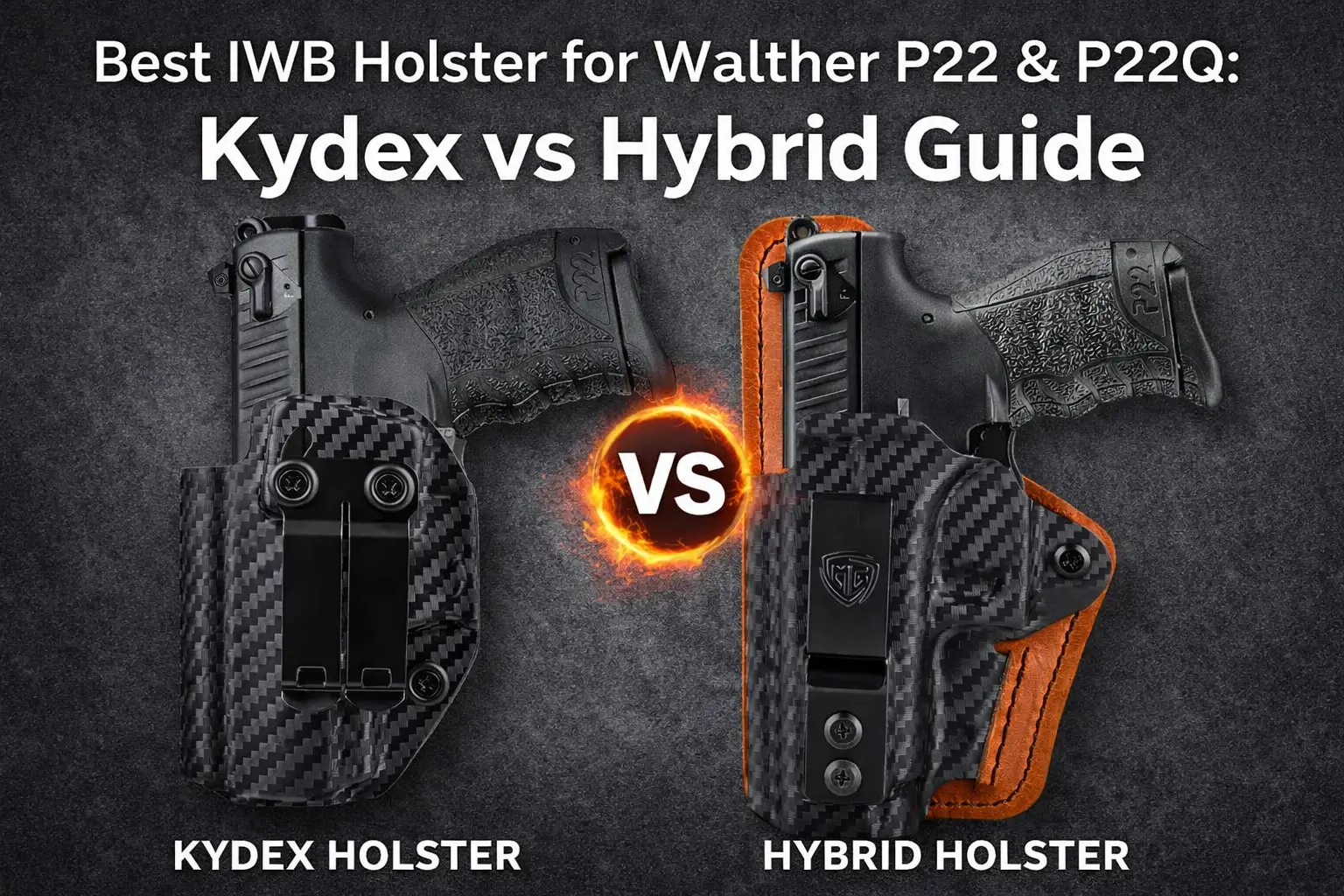
Best IWB Holster for Walther P22 & P22Q: Kydex vs Hybrid Guide If you carry
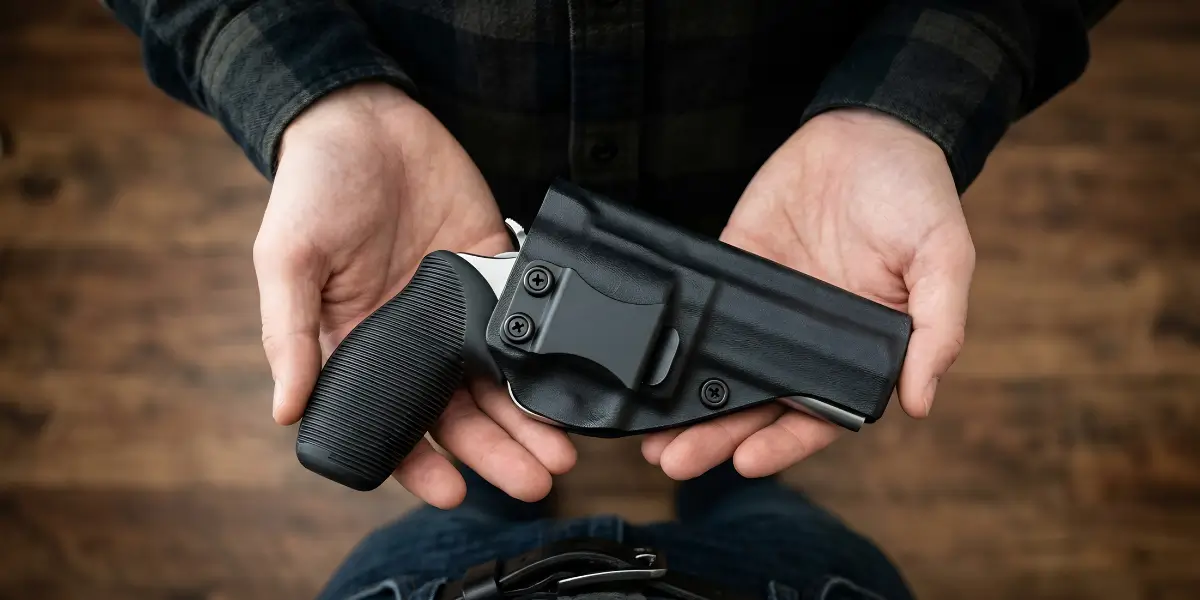
Best Taurus Tracker 627 / 44 Holster – 4″Inch Barrel: Complete Carry Guide Carrying a